


Enzyme
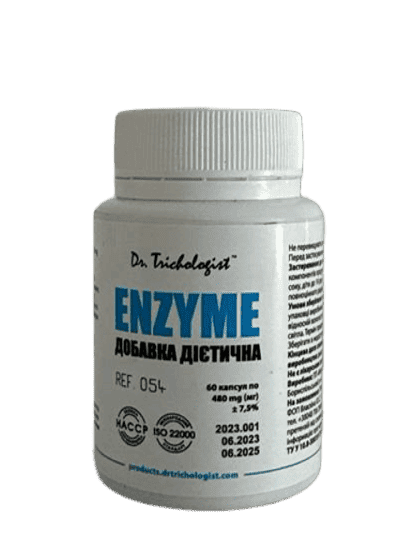
6. Dietary supplements by Dr. Trichologist
Enzymes or ferments are biological catalysts of a protein nature that selectively and directionally accelerate the chemical transformations in the body that make up the metabolism.
The study of enzymes – enzymology – has now become a rapidly developing field of medicine, as enzymes are used in various fields, ranging from gastroenterology, cardiology, traumatology, dermatology and finishing with gynecology, endocrinology.
It is difficult to find a field where their use would not be justified.
Systemic enzyme therapy (SET) is based on the oral administration of hydrolytic enzymes mainly of proteolytic action of animal (trypsin, chymotrypsin), plant (papain, bromelain) and microbial origin. SET provides for the systemic effect of enzymes on a number of both physiological and pathological processes.
SET drugs are produced in the form of pills or tablets coated with a special shell that protects enzymes from the inactivating effect of gastric juice and duodenum.
Proteolytic enzymes play an essential role in such important biological processes as protein metabolism, blood clotting, fibrinolysis, immune reactions, regulation of blood pressure, processes of differentiation and metabolism of connective tissue, etc. (Veremeenko K.N., Kovalenko V.N. (ed.), 2000).
Enzymes perform important protective functions, neutralizing both exogenous (coming from the external environment) and endogenous (formed in the body itself) toxic substances; the latter are subjected to various reactions of oxidation, restoration and, finally, decomposition into products that lose their toxic properties under the action of enzymes (Berezov T.T., 1996).
Application:
The Dr. Trichologist line includes 2 enzyme products: “Enzyme” and “Ultraenzyme”
They differ in the additional content of betaine and pepsin in Ultraenzyme, which allows it to be used for the correction of hypoacid conditions.
The recommended dosage is from 1 to 3 capsules with a meal. It all depends on the patient’s condition. We advise the patient to go with their feelings: if the swelling resolves, the stool normalizes within 3 days, it is possible to take the minimum dosage. Otherwise, it can be increased. When liquid stool appears, reduce the dose accordingly.
The use of enzyme drugs now is the key to a healthy microbiota, maintenance of the immune system, assistance in the absorption of various nutrients, and treatment of gastritis, IBS, cholecystitis, pancreatitis.
Contraindications: gastric and duodenal ulcer, acute gastritis (for Ultraenzyme).
• PMID: 7713467
• Enzyme therapy – an alternative in treatment of herpes zoster. A controlled study of 192 patients
• PMID: 32351061
Systemic enzyme therapy for treatment of women with chronic recurrent bacterial cystitis
• PMID: 32897012
Evaluation of the influence of systemic enzyme therapy on immune reactions in genitourinary chlamydia infection
• PMID: 32639458
Response to Letter: Effectivity of Pancreatic Enzyme Replacement Therapy in Malnourished Children
• PMID: 9355682
Outlooks of systemic enzyme therapy in rheumatoid arthritis and other immunopathological diseases
DR. TRICHOLOGIST ENZYME DRUG COMPOSITION
The anti-inflammatory properties of serrapeptase (serratiopeptidase), a proteolytic enzyme of natural origin, have been used in clinical practice for more than 25 years in Europe and Asia (Germany, Japan, etc.). In nature, serrapeptase is formed in the intestines of the silkworm. This enzyme is involved in digestion, and is also used by the silkworm to dissolve the cocoon.
Serrapeptase is a proteolytic enzyme isolated from the non-pathogenic intestinal bacterium Serratia E15. It has a fibrinolytic, anti-inflammatory and decongestant effect. In addition to reducing the inflammatory process, serrapeptase reduces the severity of pain by reducing the release of biogenic amines from inflamed tissues.
Serrapeptase binds to α2-macroglobulin of the blood in a 1:1 ratio, which masks its antigenicity, but retains its enzymatic activity. Serrapeptase slowly turns into exudate in the focus of inflammation and makes its level in the blood decrease gradually . By hydrolysis of bradykinin, histamine and serotonin, serrapeptase directly reduces dilation of capillaries and controls their permeability. Serrapeptase blocks plasmin inhibitors, thereby contributing to its fibrinolytic activity (use in coronavirus infection).
Papain is a proteolytic enzyme isolated from papaya. It breaks down proteins into amino acids and peptides, reduces pain, inflammation, and swelling. Improves digestion, reduces protein putrefaction, fermentation in the intestine. It has been proven to be effective for allergies, food toxicoinfections, diarrhea.
Bromelain, extracted from pineapple, has anti-inflammatory, analgesic effect. Its clinical efficacy in the treatment of osteoarthritis, rheumatoid arthritis, as well as traumatic joint lesions has been proven.
Amylase is a digestive enzyme able to break down carbohydrates.
The largest amount of amylase is found in the salivary and pancreatic glands.
Amylase, which is produced in the pancreas, i.e. pancreatic amylase (P-type), is part of the pancreatic juice, hydrolyzes starch and carbohydrates, unloads the pancreas.
Bovine bile contains taurine, a sulfur-containing amino acid that activates metabolic processes, regeneration, and the creation of new cells (NIH study, National Institutes of Health, USA). Taurine contained in bile acids helps to kill invading bacteria and provide long-term protection against infections, in particular caused by opportunistic bacteria Klebsiella pneumoniae (Kpn).
Scientists noticed that the microbiota, which had previously suffered an infection and was transmitted to sterile mice, helped prevent Kpn infection. They identified a class of bacteria – Deltaproteobacteria – involved in the fight against these infections, and further analysis allowed them to identify taurine as the trigger of Deltaproteobacteria activity as is said in the report.
Taurine helps the body digest fats and oils and is naturally found in bile acids in the intestine; its byproduct is hydrogen sulfide.
Scientists believe that low levels of taurine allow pathogens to invade the intestines, while high levels produce enough hydrogen sulfide to prevent this. It was found that one mild infection is enough to prepare the microbiota to withstand subsequent infection.
The study showed that taurine, which was injected into mice as an additive to drinking water, also prepared the microbiota to prevent infection. However, when the mice drank water containing bismuth subsalicylate — a common over-the-counter medication used to treat diarrhea and indigestion – protection against infections was weakened because bismuth suppresses the production of hydrogen sulfide.
So, bovine bile helps with stagnant processes in the gallbladder, has beneficial anti-inflammatory and warming effects, acts antiseptically on pathogenic and opportunistic flora in the intestine, which plays a key role in the formation of a healthy intestinal microbiota.
Lipase is an enzyme of the pancreas that breaks down fats, fatty acids, and fat-soluble vitamins (A, D, E, K).
Betaine (trimethylglycine) is a participant in remethylation reactions (a donor of methyl groups) and activator of the synthesis of phospholipids of cell membranes, acts as a donor of methyl groups in the conversion of homocysteine to methionine. It is an indispensable assistant for genetic breakdowns of the folate cycle and participates in the processes of DNA methylation and synthesis of cell membrane components. It has been proven to be effective as a hepatoprotector, as well as a source of hydrochloric acid in case of hypoacidity.
Pepsin is a proteolytic enzyme present in gastric juice; it breaks down proteins to amino acids in the presence of hydrochloric acid.
only according to the doctor's prescription.
Sign up for a consultation
doctor in your city RIGHT NOW!
The doctor's consultation


The doctor's consultation
Спасибо, Ваша заявка успешно принята. Мы свяжемся с Вами в ближайшее время
The doctor's consultation
